DigestSync Reviews: What This Gut Health Powder Contains and What the Evidence Really Supports
By the Greenara Editorial Team · Updated October 2026
Disclosure: this article contains affiliate links. If you buy through them, we may earn a commission at no extra cost to you. It does not change what we write.
DigestSync at a Glance
| Form | Powder — 1 scoop (3 g) mixed into 8–16 oz of liquid once a day; 30 servings per 90 g jar |
| Core ingredients | 2.4 g proprietary blend: pea starch, wildcrafted baobab, Sukre, konjac glucomannan, biogenic polyamines; sweetened with stevia |
| Made in | Assembled in the USA; label states an FDA-registered facility |
| Guarantee | 60 days, counted from the delivery date |
| Shipping (US) | Free on the 6-jar package; the shipping policy lists free US delivery in 5–7 working days (confirm at checkout for 1 and 3 jars) |
| Main caution | Glucomannan must be mixed with plenty of liquid; take it apart from medications and check with a doctor if you have swallowing or bowel problems |
Bloating after meals, trapped gas and a sense that digestion has slowed down are among the most common everyday complaints, and they become more frequent with age, stress, travel and changes in diet. The supplement aisle offers a huge range of answers, from probiotics to enzymes to fiber blends. DigestSync takes a slightly different angle: it is a powder you stir into a drink, and its marketing ties digestive comfort to the vagus nerve.
In this review we go through the published Supplement Facts label, explain what the vagus nerve actually does in digestion and how much of the brand's story holds up, examine each ingredient against the research, and lay out the price, shipping and refund terms as they appear on the official website. Nothing here is a substitute for medical advice, but it should help you decide with realistic expectations.
→ See the DigestSync label and current offer on the official website
What Is DigestSync?
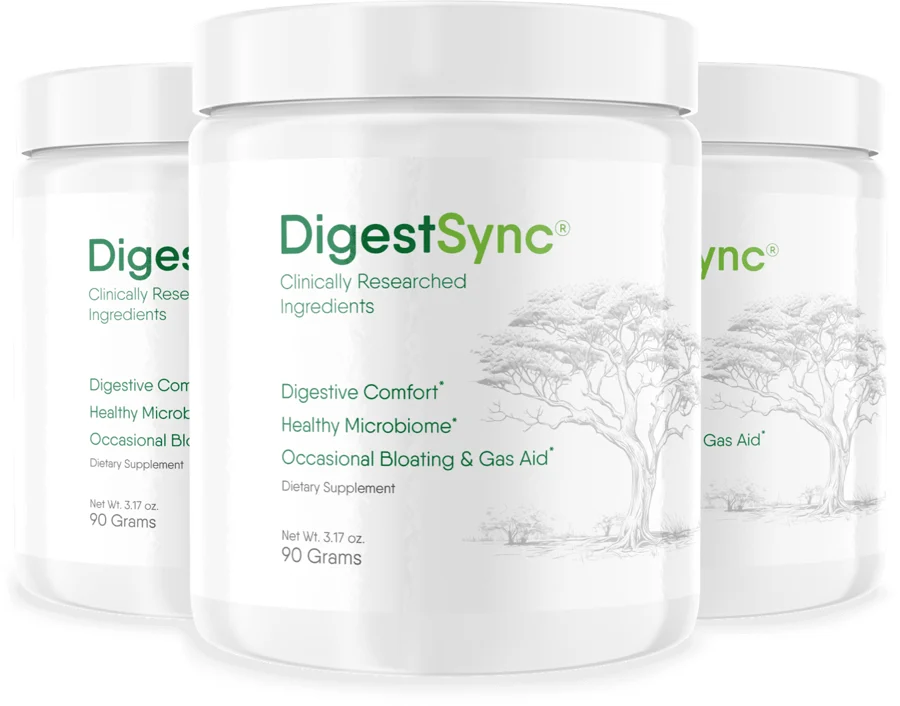
DigestSync is a dietary supplement sold as a flavored powder in a 90 g (3.17 oz) jar. One serving is a single 3 g scoop, so each jar provides 30 servings, or one month at one scoop a day. The front of the jar lists three intended benefits: digestive comfort, a healthy microbiome and help with occasional bloating and gas.
According to the label published on the official website, each scoop contains a 2.4 g proprietary blend of pea starch, wildcrafted baobab, Sukre, konjac glucomannan (Amorphophallus konjac) and biogenic polyamines. The other ingredients are silicon dioxide (an anti-caking agent), natural flavors and stevia. The sales page calls it a natural, non-GMO, stimulant-free formula.
The label says the product was assembled in the USA and manufactured in an FDA-registered facility, and it is distributed from Largo, Florida. Registration means the facility is listed with the FDA, nothing more: the FDA does not approve supplements or check that they work before they are sold, and the label carries the usual notice that its claims have not been evaluated by the agency. Some answers on the brand's FAQ page describe the facility with stronger, approval-style wording, which you should read in that light.
How DigestSync Is Said to Work: The Vagus Nerve Claim vs. the Evidence
The official page presents DigestSync as a formula that supports the vagus nerve, which it describes as essential for moving food from the stomach to the intestines, and that supports a healthy inflammatory response. Its FAQ explains that inflammation, which it links to widespread antibiotic use, can damage the vagus nerve and disrupt digestion. Another FAQ answer goes further, saying the formula restores the gut lining and fixes gut problems "for good".
The first part is real physiology. The vagus nerve connects the brainstem to most of the digestive tract and helps control stomach emptying, gut movement and the secretion of digestive juices. Scientists are actively studying the gut-brain connection, and electrical vagus nerve stimulation is being researched for some inflammatory bowel diseases.
What is missing is a link between those facts and this product. None of DigestSync's ingredients has been shown in human studies to repair or "retrain" the vagus nerve, and the references the brand lists on the vagus nerve concern nerve physiology and electrical stimulation, not supplements. Statements about fixing digestion permanently are not supported by any trial. A more accurate description is simpler: DigestSync is a low-dose fiber and prebiotic drink mix. Soluble fibers do have real evidence for regularity and for feeding gut bacteria, and that is the most reasonable basis for any benefit you might notice.
DigestSync Ingredients and What the Research Says
All five active ingredients share one 2.4 g blend, and the label does not say how much of each is included. That matters more than usual here, because fiber studies generally use several grams of a single fiber per day. Here is what each ingredient brings.
1. Pea Starch
Pea starch comes from yellow or green peas and is listed first, which suggests it is the largest component by weight. Pea starch naturally contains a share of resistant starch, a type of carbohydrate that escapes digestion in the small intestine and is fermented by bacteria in the colon, much like a prebiotic fiber. A 2023 review of pea research describes these properties, but the label does not state whether the starch used is a resistant-starch form or an ordinary filler, so its contribution is hard to judge.
2. Wildcrafted Baobab
Baobab fruit pulp is a tangy powder from the African baobab tree, the tree illustrated on the jar. It is naturally high in soluble fiber, vitamin C and polyphenols. Small human studies from Oxford Brookes University found that baobab extract reduced starch digestion and the blood sugar rise after a meal (2013) and that a baobab drink modestly increased feelings of fullness (2017). Studies on bowel habits specifically are scarce.
3. Sukre
"Sukre" appears on the label without any explanation, and the sales page does not describe it either. It appears to be a branded ingredient name. We could not confirm from official pages what it is or how much of it is present, so we cannot comment on its effects. If this matters to you, for example because of a food sensitivity, ask the support team before ordering.
4. Konjac Glucomannan
Glucomannan is a highly viscous soluble fiber from the konjac root, and it is the ingredient in DigestSync with the strongest digestive evidence. A placebo-controlled trial in constipated adults (2008) found that glucomannan increased bowel movement frequency and improved the balance of colonic bacteria, and a 2017 meta-analysis found benefits for functional constipation in children. Those studies typically used a few grams a day on their own; DigestSync's entire blend is 2.4 g split among five ingredients, so the dose is likely to be lower. Glucomannan absorbs many times its weight in water, which is also why it carries a choking caution (see Safety).
5. Biogenic Polyamines
Polyamines such as spermidine, spermine and putrescine are compounds found naturally in foods like wheat germ, soybeans, mushrooms and aged cheese, and they play roles in cell growth and repair. Laboratory and animal studies, including mouse research cited by the brand, suggest spermidine can help maintain the intestinal barrier. Human evidence for gut outcomes is lacking, and a 2022 randomized trial of spermidine supplements in older adults found no improvement in its main memory outcome over a year. The label does not say which polyamines are used or at what dose.
Notably, DigestSync contains no probiotic bacteria. Its "healthy microbiome" claim relies on prebiotic-type fibers (glucomannan, baobab and possibly pea starch) that feed the bacteria you already have, an idea that is well accepted in principle by the International Scientific Association for Probiotics and Prebiotics.
Prefer a drink mix to capsules? Check the current DigestSync packages on the official site.
Visit the Official DigestSync Website →Pros and Cons of DigestSync
Pros
- Full Supplement Facts label published on the official website
- Built on soluble fibers, the category with the most consistent evidence for regularity
- Powder format with no capsules to swallow; sweetened with stevia, no added sugar listed
- No stimulants and a short ingredient list
- One-time purchase with no autoship, and a 60-day refund window
Cons
- Individual doses hidden in a small 2.4 g proprietary blend
- The vagus nerve and "fix it for good" claims are not backed by human studies
- "Sukre" and the type of polyamines are not explained on the label
- Glucomannan requires plenty of liquid and can interfere with medication timing
- Refund requires returning all jars at your own postage cost
Who Might Consider DigestSync (and Who Should Not)
DigestSync may suit adults who:
- have occasional bloating, gas or irregularity and do not get much fiber from their diet
- prefer a drink mix to swallowing pills
- want a fiber-based approach rather than a probiotic
- are happy to give it several weeks while keeping a simple diary of symptoms
It is not a good fit, or needs medical advice first, for people who:
- have difficulty swallowing, a narrowed esophagus or a history of bowel obstruction, because glucomannan swells in liquid
- take diabetes medication, since viscous fibers can lower blood sugar after meals
- take medications that must be absorbed reliably, such as thyroid hormone, which fiber can delay
- are pregnant, nursing or under 18, as the label itself advises
- have ongoing digestive symptoms that have never been evaluated, including pain, weight loss, blood in the stool, vomiting or a recent change in bowel habits
Bloating and gas are usually harmless, but they also overlap with conditions such as celiac disease, lactose intolerance, small intestinal bacterial overgrowth and inflammatory bowel disease, which need a proper diagnosis.
Safety and Side Effects
There are no published safety studies on DigestSync as a finished product. Its ingredients are mostly food-derived and generally well tolerated, but a few points deserve attention:
- Gas and fullness at first: fermentable fibers can temporarily increase gas and bloating, the very symptoms people want to reduce. Starting with half a scoop for the first week can help.
- Choking and blockage risk: glucomannan expands when it absorbs water. Always dissolve the scoop completely in the full 8–16 oz of liquid, drink it right away and do not take it dry or just before lying down.
- Medication timing: soluble fiber can slow the absorption of other medicines; a common rule is to take them at least an hour before or a few hours after.
- Blood sugar: glucomannan and baobab may blunt the rise in blood sugar after meals, which is relevant for people on insulin or other glucose-lowering drugs.
- Unknown components: because Sukre and the polyamine source are not described, people with food allergies should ask the company for details.
The label adds its own caution: do not exceed the recommended dose, and pregnant or nursing women, anyone under 18 and people with a known medical condition should consult a physician first.
How to Use DigestSync
Add one scoop to 8–16 oz of water or another drink and mix thoroughly, once a day. The brand's FAQ suggests taking it in the morning, before breakfast, with a tall glass of water. Using the larger amount of liquid makes sense given the glucomannan content, and drinking enough water through the day helps any fiber supplement work more comfortably.
Store the jar away from heat, light and humidity, and do not use it if the safety seal is damaged. The refund policy recommends at least three months of use before deciding, but changes in regularity from fiber, if they happen, usually appear within one to three weeks. A short daily note of bloating and bowel habits makes it easier to judge honestly, and to decide within the 60-day window.
DigestSync Price, Shipping and Guarantee
DigestSync is sold in three packages on its official website. The per-jar prices are shown as images on the order page; at the time of our check they were:
| Package | Price shown on the official site |
|---|---|
| 1 jar (30-day supply) | $69 per jar (about $69 total) |
| 3 jars (90-day supply) | $59 per jar (about $177 total) |
| 6 jars (180-day supply) | $49 per jar (about $294 total) + 2 digital bonuses |
| US shipping | Free on 6 jars; policy page lists free US delivery, 5–7 working days |
| Canada, UK, Ireland, Australia, NZ | $15.95, 10–15 working days |
| Guarantee | 60 days from the delivery date |
The order page currently marks only the 6-jar package with free shipping, while the shipping policy page lists free delivery on all US orders, so check the shipping line at checkout before paying for one or three jars. The two bonuses with the 6-jar package are e-books, one on healthy aging habits and one on vagus nerve exercises. The FAQ states that every order is a one-time purchase with no hidden autoship, and the shipping policy promises a tracking email within 60 hours.
Complaints and Refunds: What the Policy Says
The sales page summarizes the guarantee as simply writing in for a refund, but the full refund policy sets out more steps. You need to email support with "Refund Request" in the subject within 60 days of delivery, then send back all jars, opened, unopened or empty, with the packing slip and a note with your name and email to the Largo, Florida address. Return shipping is paid by the customer. Refunds are processed after the return arrives, and the bank may take five to ten days to show it. Keep your tracking number and delivery date handy.
→ Check today's DigestSync price and packages on the official website
What We Saw on the Official DigestSync Order Page (October 13, 2026)
On October 13, 2026 we opened the official order page ourselves and followed the checkout up to the payment step, without placing an order, to record exactly what a buyer sees. The screenshots below are unedited crops from that visit.

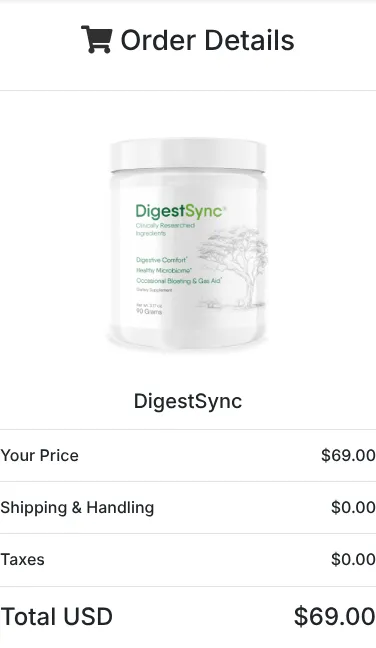
- At the secure checkout the bundles came to: DigestSync: $69.00 with free shipping; DigestSync - 3 Jars: $177.00 with free shipping; DigestSync - 6 Jars: $294.00 with free shipping. Tax showed as $0.00.
- Contact address listed on the official site: contact@digestsync-product.com.
DigestSync vs. a Plain Fiber Supplement
It is worth comparing DigestSync with a simple single-ingredient fiber such as psyllium or plain glucomannan from a pharmacy. Those products state an exact dose per serving, cost considerably less per month and have a larger body of research behind them. DigestSync's advantages are the combination of several fibers with baobab and polyamines, a flavored drink format and the 60-day guarantee. If your main goal is regularity, a measured dose of a well-studied fiber is the benchmark it has to beat; if you like the blend and the format, DigestSync is a reasonable alternative to try.
Where to Buy DigestSync
DigestSync is sold through its official website. Jars from marketplaces or unknown sellers may not be covered by the 60-day guarantee and could be expired or imitation stock. The official order page is the safest way to get the genuine product with the published refund terms.
Final Verdict
DigestSync is a short, readable formula built around soluble fibers, the one area of digestive supplements with fairly consistent evidence for regularity and gut bacteria. Konjac glucomannan and baobab are sensible choices, and the powder format with stevia makes it easy to take daily.
The weak points are a small blend with undisclosed doses, an ingredient (Sukre) the brand never explains, polyamines with mostly animal data, and a vagus nerve story that goes well beyond the science. If you are generally healthy, can take it with plenty of liquid, keep it apart from your medications and want to see whether a fiber drink eases occasional bloating, DigestSync is a reasonable option to try under its 60-day guarantee. Go in expecting gentle support, not a permanent fix, and see a doctor about any symptom that persists.
Frequently Asked Questions (FAQs)
Is DigestSync FDA-approved?
No. The FDA does not approve dietary supplements. The label says DigestSync is made in an FDA-registered facility, which concerns manufacturing, not proof that it works.
Does DigestSync contain probiotics?
No. The label lists no live bacteria. It relies on fibers such as konjac glucomannan and baobab that feed the bacteria already in your gut.
Can DigestSync heal the vagus nerve?
There is no human evidence that DigestSync or its ingredients repair the vagus nerve. Any benefit is more likely to come from its soluble fiber content.
Does DigestSync have side effects?
Extra gas or fullness is possible in the first days. Glucomannan must be mixed with plenty of liquid to avoid choking, and fiber can delay the absorption of medications.
How do I take DigestSync?
Mix one scoop (3 g) into 8 to 16 oz of liquid once a day; the brand suggests the morning, before breakfast.
Is DigestSync a subscription?
No. The official site states each order is a one-time purchase with no autoship.
How do I get a refund?
Email support with "Refund Request" in the subject within 60 days of delivery and return all jars with the packing slip. Return postage is your cost.
Want to compare the current DigestSync packages? The official site shows today's prices.
Visit the Official DigestSync Website →References
- Chen HL, Cheng HC, Wu WT, Liu YJ, Liu SY. Supplementation of konjac glucomannan into a low-fiber Chinese diet promoted bowel movement and improved colonic ecology in constipated adults: a placebo-controlled, diet-controlled trial. J Am Coll Nutr. 2008;27(1):102-108.
- Han Y, Zhang L, Liu XQ, Zhao ZJ, Lv LX. Effect of glucomannan on functional constipation in children: a systematic review and meta-analysis of randomised controlled trials. Asia Pac J Clin Nutr. 2017;26(3):471-477.
- Coe SA, Clegg M, Armengol M, Ryan L. The polyphenol-rich baobab fruit (Adansonia digitata L.) reduces starch digestion and glycemic response in humans. Nutr Res. 2013;33(11):888-896.
- Garvey R, Clegg M, Coe S. The acute effects of baobab fruit (Adansonia digitata) on satiety in healthy adults. Nutr Health. 2017;23(2):83-86.
- Gibson GR, et al. Expert consensus document: The International Scientific Association for Probiotics and Prebiotics (ISAPP) consensus statement on the definition and scope of prebiotics. Nat Rev Gastroenterol Hepatol. 2017;14(8):491-502.
- Wu DT, et al. A comprehensive review of pea (Pisum sativum L.): chemical composition, processing, health benefits, and food applications. Foods. 2023;12(13):2527.
- Schwarz C, et al. Effects of spermidine supplementation on cognition and biomarkers in older adults with subjective cognitive decline: a randomized clinical trial. JAMA Netw Open. 2022;5(5):e2213875.
- Bonaz B, Sinniger V, Pellissier S. Therapeutic potential of vagus nerve stimulation for inflammatory bowel diseases. Front Neurosci. 2021;15:650971.
- National Institute of Diabetes and Digestive and Kidney Diseases (NIDDK). Gas in the Digestive Tract.
- MedlinePlus (U.S. National Library of Medicine). Glucomannan — Herbs and Supplements.
This review is for general information only and is not medical advice. Product details (ingredients, prices, guarantee) come from the official DigestSync pages as checked in October 2026; they can change, so confirm them at checkout. Talk to your doctor before starting any supplement, especially if you take prescription medication or have a health condition.